What does socialisation and habituation mean for your dog?
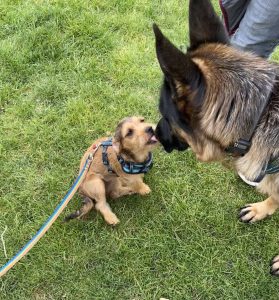
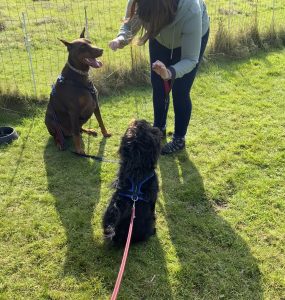
People often contact me wanting to socialise their puppies/dogs. They want to join a class and let their dog meet other dogs and here’s nothing wrong with that for most dogs.
It is how it is done that is key to the learning experience for each dog.
In classes we do make sure that dogs have the chance to socialise. We do this in several ways:
*With the dogs from a distance
*On a one to one basis (on-lead & off-lead)
*Off lead as a group
*On a social walk.
But….if you let your dog meet and greet every dog and person they see, that then becomes the ‘norm’ for them. They will expect to go up to every dog and person they see when out and about.
When you have a puppy or a new dog it seems the right thing to do – this is socialisation isn’t it? Well not quite!
If you think about how you want your dog to react and behave when out on a walk, would you want them to drag you across the road to say ‘hello’ to your neighbour, the local Labrador, Terrier, delivery driver etc? Not really ideal is it?
Socialisation and habituation is about your dog learning to look to you for guidance on what they should do in different situations and environments.
Gentle, step by step interactions with you when out on a walk will help them to cope with new dogs and people from a distance. If you encourage them to go past a dog or person, they will learn that they don’t get to meet them every time they see them in the distance.
Habituation – this is about your dog learning to cope with and accept different environments and situations.
Just as we humans know and understand the sights, sounds and smells we come across in daily life, so our canine companions need the opportunity to experience, absorb, process and learn about these same things. Keeping it positive is the important part!
*Take your time to set your puppy/dog up for success – give them time!.
*Don’t overwhelm them with an environment which is too stimulating or scary.
*Step in and stop people if they want to stroke, or approach your dog and you (or your dog) don’t want this attention.
*Watch your dog’s body language – they will tell you how comfortable they are in a new situation or environment.
*Don’t force your dog to say hello or cope with a new experience. If they are unsure, respect this and give them time and space to learn to cope.
Socialisation and habituation for your dog is all about learning to live and cope in the human world.
Advocate for your dog!